Tuesday, October 5, 2010

Mondays In the Sun ****


Original Title: Los lunes al sol

Director: Fernando León de Aranoa
Year: 2002
Writers: Fernando León de Aranoa, Ignacio del Moral
Cinematographer: Alfredo F. Mayo

Friday, October 1, 2010

The White Ribbon *****


Writer/Director: Michael Haneke
Year: 2009
Cinematographer: Christian Berger

I know I've just seen a great film, and I feel that the images and characters and mysterious, dubious story will stay with me a long time... but beyond saying that the black and white cinematography is masterful, and making the vague statement that the film is perfectly woven, I do not feel prepared at this moment to defend my opinion that this is a masterpiece of cinema. I am bewitched by the film and must ponder it and perhaps even see it again before I can feel adequately prepared to tackle an analysis or criticism.

This film satisfied me as a film lover, and whetted my appetite for cinema; it reminded me that I know great cinema when I see it, and need not elevate good films to a great status just because of my desire to have the "great film" experience. More than half my list of 5 star reviews don't deserve to be considered on the same level as this work of cinematic art.

Tuesday, September 14, 2010

Lawrence of Arabia *****


Director: David Lean
Year: 1962
Based on writings by T.E. Lawrence
Screenplay by: Robert Bolt, Michael Wilson
Cinematographer: Freddie Young

Saturday, September 11, 2010

Babel ****


Director: Alejandro González Iñárritu
Year: 2006
Writers: Guillermo Arriaga
Cinematographer: Rodrigo Prieto

21 Grams ****


Director: Alejandro González Iñárritu
Year: 2003
Writer: Guillermo Arriaga
Cinematographer: Rodrigo Prieto

Sunday, September 5, 2010

El Infierno *****


Translated Title: "Hell"

Director: Luis Estrada
Year: 2010
Writers: Luis Estrada, Jaime Sampietro
Cinematographer: Damian Garcia

Here is some great film making, perhaps not as polished as Scorcese, but much more powerful. Here is a film who's relevance to its native culture is immense. A film that speaks to Mexico, satirizing its culture in a serious way... totally rooted in truth, and despite the despair felt by the director at the condition of this culture, he doesn't weigh the film down with that despair... he appropriately finds moments for comic relief, understanding that laughing at the culture is a strong form of critique, and yet avoids joke-making. This is a film by mexicans, for mexicans, satirizing the mexican drug-cartel culture. The prelude to the film portrays the poor mexican who decides to go to the US looking for a better life... 20 years later, he's deported back to Mexico and shocked to find that things are WORSE now than when he left 20 years ago (economic crisis, drug war) he finds that the only way to meet his economic needs is to become a narco-trafficer. Then greed and all the pitfalls common among the foolishly greedy befall the hero as he becomes more and more involved... finally ending in a massacre motivated by personal reasons. And there the film seems to end, with this sarcastic 2010 Mexican Bicentennial Celebration of the Mexican Independance which proclaims "nothing to celebrate." Look at the condition Mexico is in, you either starve, or you join the narco-trafficers and you participate in brutal violence until you and your family meet their own violent ends.

The script is marvelously thought out, giving each character a fully developed arch with symbolic meaning. Everyone is bought by their greed for money, although they originally object to the narcotics trafficking... they come around to the idea of being rich no matter the source of the blood money. The film is actually structured very similarly to another great film directed by Luis Estrada, "La Ley de Herodes" which was a critique of the mexican political system, especially the power of the PRI political party which had unchallenged control over the country for more than 70 years, this film even stars the same actor, Damián Alcázar. Alcázar is great in his role, as is Joaquín Cosio as El Cochiloco.

The most poignant part is the epilogue in which after we see the gruesome decline of everyone in the movie, the main character's nephew, the lone survivor and symbol of the next generation, the hope of mexico... decides to "continue the family tradition of idiocy" and become a "narco", thus implying that the cycle continues, and we thus know already that the boy will also meet a bloody fate... it stands as a warning to the youth of mexico looking to get rich quick with the narco-trafficker way of life... and yet the film is not a "don't join the narco-traffickers" message film, its much bigger than that, it satirizes the corruption of the mexican government, and the complicity of even Federal Police and elected officials, and how they all live on the drug-cartel pay-roll because the bribes offered are greater than their government-paid monthly salary. And with an economy so broken that it offers no other jobs that might be pathways to the middle-class, and the United States which deports you back to Mexico... there is no good option... welcome to hell, Viva Mexico!

Thursday, September 2, 2010

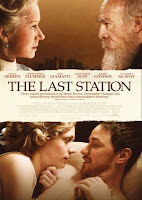
The Last Station ****


Director: Michael Hoffman
Year: 2009
Novel by: Jay Parini
Adapted by: Michael Hoffman
Cinematographer: Sebastian Edschmid

I feel that it is rare in cinema for someone to critique a liberal, or even more rare, to portray a character in a sincere pursuit of christianity. For being one of the world's main religions, western cinema seems bound and determined to avoid discussing religion and spiritualism in a serious way, and even here, the film manages to scoot around the motivator of its main character... Tolstoy was a christian who from within the religion, fought through his writings to bring it back to the core teachings of Jesus, he advocated peaceful resistance and rejection of the idea of personal property, and his motivation was a love for God and goodness.

But while the script dances around its ideals and avoids serious discussion of God, spiritualism, religion... it does offer up a very good and interesting look at the tensions between idealism and reality. Specifically, the very common contemporary summation of meaning/spirituality/religion which says "its all about love", "all you need is love" "love is the answer" etc. etc. etc.

For many agree on the statement that love is the key, and Tolstoy is right in saying that love is the core of religion (or ought to be) the reality is that every one of us "love and peace"nics fails miserably at applying the principle of love in our everyday lives, in the very real and tangible relationships with our families and friends, even our spouse.

So the ideological men searching exhaustively for intellectual ways to understand their existence try to purify the christian religion by abandoning the strict doctrines of the organized church by returning to the love and freedom you find in the words of Jesus in the gospels. However, these men delude themselves, they live as hypocrites, not understanding how to love and sacrifice their ideals for the sake of the real, flesh and bone women who love them.

Its built upon very old stereotypes, the women want freedom, to live life, enjoy the physical pleasures of sex and wealth without worrying about the rules, but their selfishness manifests itself as materialistic or shallow... while the men self-righteously and very seriously search for a perfect rigid ideology, a code to live by that will keep them clean and pure and sinless but for all their sincerity, cannot avoid that their selfishness manifests itself as being coldy withdrawn from their loved ones, sacrificing real relationships for intangible ideas. But fortunately, the film goes beyond these stereotypes to deliver complete characters.

The movie succeeds because it lives in the tension, the paradox of these things. Each character being sincere, capable of love and great compassion, but also selfish and close-minded. They live in grey, each one still far from perfect, and most of all, the man regarded as a saint, a prophet, a genius.

A very good story, I felt a personal connection to it, because I see myself in these men... eager to intellectually pursue a way of understanding the world, which, if I abide to, will purify me... and yet despite my self-righteousness, I continually fail to show real love to my loved ones and to live out the ideology I profess. You see in these relationships why people are better off in a relationship than left to their own devices... love and relationship is messy, difficult, full of ups and downs, but those conflicts sharpen us, make us better people because our faults are reigned in by the good side of our partner, and their faults are reigned in by our good side. Two are better than one, but keeping two together is not easy.

I really enjoyed the bits of original russian paparazzi footage of Tolstoy, a very nice touch to anchor the story to reality. Well directed and acted, though nothing really stood out as excellent more than the script. Solid movie.

Monday, August 23, 2010

The Devil Wears Prada ***


Director: David Frankel
Year: 2006
Novel by: Lauren Weisberger
Adapted by: Aline Brosh McKenna
Cinematographer: Florian Ballhaus

Batman **


Director: Tim Burton
Year: 1989
Writers: Sam Hamm, Warren Skaaren
Cinematographer: Roger Pratt

Batman Begins ***


Director: Christopher Nolan
Year: 2005
Writers: David S. Goyer, Christopher Nolan
Cinematographer: Wally Pfister

Brothers ***


Director: Jim Sheridan
Year: 2009
Based on the film "Brødre" directed by Susanne Bier
Adapted by: David Benioff
Cinematographer: Frederick Elmes

Saturday, August 14, 2010

Marie Antoinette ****


Writer/Director: Sofia Coppola
Year: 2006
Cinematographer: Lance Acord

The Prestige ****


Director: Christopher Nolan
Year: 2006
Novel by: Christopher Priest
Adapted by: Christopher Nolan, Jonathan Nolan
Cinematographer: Wally Pfister

Friday, August 13, 2010

Blow-Up *****


Director: Michelangelo Antonioni
Year: 1966
Short story by: Julio Cortázar
Adapted by: Michelangelo Antonioni, Tonino Guerra
Cinematographer: Carlo Di Palma

Taxi Driver *****


Director: Martin Scorsese
Year: 1976
Writer: Paul Schrader
Cinematography: Michael Chapman

Batman: The Dark Knight ****


Director: Christopher Nolan
Year: 2008
Based on "Batman" comics, created by: Bob Kane
Writers: Christopher Nolan, Jonathan Nolan, David S. Goyer
Cinematographer: Wally Pfister

Monday, August 2, 2010

Buffalo '66 *****


Director: Vincent Gallo
Year: 1998
Writers: Vincent Gallo, Alison Bagnall
Cinematographer: Lance Acord
Original Music: Vincent Gallo

Saturday, July 31, 2010

Full Metal Jacket *****


Director: Stanley Kubrick
Year: 1987
Novel "The Short Timers" by: Gustav Hasford
Adapted by: Stanley Kubrick, Michael Herr, Gustav Hasford
Cinematographer: Douglas Milsome

The Door in the Floor ****


Director: Tod Williams
Year: 2004
Book by: John Irving
Adapted by: Tod Williams
Cinematographer: Terry Stacey

Inception ****


Writer/Director: Christopher Nolan
Year: 2010
Cinematographer: Wally Pfister

This is a really fun crime-thriller/sci-fi/dream flick with some really great action sequences, and I really can't wait to see it a second time to watch for how it was shot and pay more attention to the technique. But I really did enjoy the story, I was sucked in for most of it, but caught myself being pulled out by trying to predict where it was going.

I really liked Tom Hardy and Cillian Murphy, I think they acted circles around the rest of the cast with much fewer lines of dialogue. Joseph Gordon-Levitt kinda annoyed me with his super serious voice.

The effects were great, and I liked the general concept of this action thriller that moves through different levels of dreams. I liked getting a little behind at a couple of points, but felt that I should have been left to be a little more lost. I would have liked to feel that Kubrick sensation of awe, of being out to sea by the end, totally lost. But ultimately, while the last shot is a really nice cliff-hanger moment, I felt disappointed because the film actually ends a little too cleanly, tying up the loose ends and then offering this doubtful moment at the end but without building in enough explanation to really make you doubt the reality of the final moment enough to mess with your mind on the level of that "starchild" kind of moment we get at the end of 2001: A Space Odyssey.

The reason this doesn't get a five star review from me is for the following reasons:
1. I don't really like DiCaprio that much in this film, or any other film for that matter. Also, his performance was basically a rehash of what he did in Shutter Island, and I never felt like I was that drawn into him... but then, that's always my complaint with DiCaprio, I never relate to him emotionally because I am always distracted by his ACTING. He acts like he's acting, he always has, and that's always been a frustration for me, because I never buy the emotions he's selling me.
2. I don't perceive my own dreams to be so organized. Random stuff happens, and the plot of my dreams seems to be in constant flux, as if my attention can't remain on one through story. So that's a problem I have with Nolan's conception of dreams here, he has architects building levels of dreams that basically follow one logic during the course of the dream, although he does switch things up by moving to another dream that has another logic. But I never really felt that the logic of the dreams were all that screwy, my dreams are way more crazy than just a city folding back on itself, thats one stunt. Then each other dream seems to have one stunt, like no gravity, or the gravity rotating from one wall to the next. In my dreams, the logic is ever-changing, or at times doesn't seem to have a logic. That's why I think Michel Gondry is cinema's greatest ever at directing dreams: my evidence, Eternal Sunshine, and The Science of Sleep. I would like to see Michel Gondry direct a Charlie Kaufman rewrite of this Christopher Nolan concept, because that would be a 5 star film.
3. Too much dialogue explaining what is going on, why they are going to die for real, why DiCaprio is screwing up the plan, etc. I hate it when Ellen Page asks these "Gee guys, why are you doing that? Could you spell it out for me and the audience please?" questions. That's a major flaw in the script I think.
4. Also, I think the choice between the dream world where DiCaprio can stay with his wife and real world where he must face the world without her was better covered in Tarkovsky's Solaris. Here, I just didn't feel the emotional weight of the decision DiCaprio makes, no matter how much eye-brow furling, squinting and lip tensing he does.

But don't get me wrong, this is a very good movie, I'm not picking it apart so much because I don't like it, I'm picking it apart because I am aware of a few things that could have made it better for me. I do like the movie, it just comes up short of that all time "WOW" list of movies occupied by some of the films I referred to in this critique.